2026 Isleib Award
The Isleib Award recognizes “outstanding contributions to bird conservation in Alaska”
and has been presented at each Alaska Bird Conference since 1994.
The award winner for 2026 will be announced in December 2026.
Nominations are due 16 October 2026. Please follow the Pete Isleib Award Nomination Instructions.

About Pete Isleib
M.E. “Pete” Isleib took his passion for birds to scientific and recreational heights. He moved to Alaska in the early 1960s and made his living as a commercial fisherman.
Pete was known for his extraordinary ornithological skills and conservation work in Alaska. His book “Birds of the North Gulf Coast-Prince William Sound Region, Alaska,” co-authored with Brina Kessel, provided some of the earliest data on avifauna of this area.
Pete Isleib died in an accident while refitting his fishing vessel in Naknek, Alaska, in 1993.
Past Recipients
- Stan Senner (1994)
- G. Vernon Byrd (1997)
- Calvin Lensink (1998)
- Jim King (2000)
- Dan Gibson (2002)
- Brina Kessel (2004)
- Bruce Conant and John “Jack” Hodges Team (2006)
- Robert Gill (2008)
- Dirk Derksen (2010)
- Russ Oates (2012)
- Brian McCaffery (2014)
- Robert J. Ritchie (2016)
- Colleen Handel (2019)
- Margaret Petersen (2021)
- Liliana Coelho Naves (2023)
2026 Isleib Award Winner
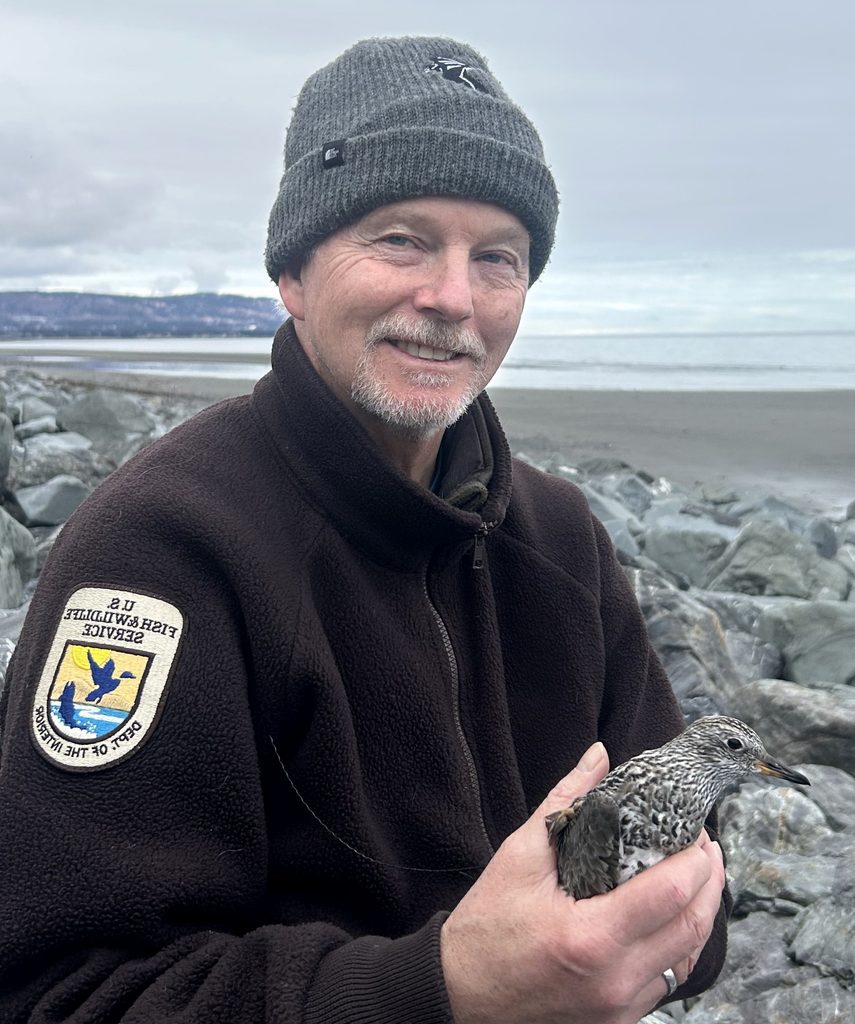
The 2026 Isleib Award of the Alaska Bird Conference recognizes Dr. Richard “Rick” Lanctot for his extraordinary leadership in advancing the global knowledge and conservation of Alaska-breeding shorebirds. Serving as the U.S. Fish and Wildlife Service – Alaska Shorebird Coordinator since 2002, Rick has built a strong scientific foundation and diverse collaborations necessary to conserve shorebirds in Alaska and throughout their global flyways.
Rick’s scientific contributions have played a major role in highlighting migratory connectivity and the global importance of Alaska for shorebirds. He has authored over 130 peer-reviewed publications and mentored over two dozen graduate students and numerous volunteers, building the next generation of scientists and conservation practitioners. Rick and many collaborators have tracked over ten Arctic-breeding shorebird species generating information crucial for the conservation of stopover sites and identification of threats. He is widely recognized for his knowledge about the Buff-breasted Sandpiper, having led collaborative studies spanning the entire species’ range from the top of North America to the pampas of South America.
Rick’s leadership has been central to understanding how Arctic-breeding shorebirds are responding to a changing climate. Building on research from the 50s–70s, he and his colleague Dr. Sarah Saalfeld have stewarded some of the Arctic’s longest-running datasets on shorebird ecology, demography, and population dynamics. Rick, together with Dr. Stephen Brown, established the Arctic Shorebird Demographic Network—to standardize data collection and management across nearly 20 circumpolar sites—and co-led the Alaska Program for Regional and International Shorebird Monitoring (PRISM), which generated population estimates for northern and western Alaska.
Rick, translating science into coordinated action, has served on many international entities including the Western Hemisphere Shorebird Group, Arctic Migratory Bird Initiative, Shorebird Science and Conservation Collective, the East Asian-Australasian Flyway Partnership’s Shorebird Working Group, and the Alaska Shorebird Group. Rick also served as the U.S. shorebird expert for the U.S.-Japan Migratory Bird Treaty, strengthening international cooperation for conservation of transboundary migratory species.
Rick’s unflagging dedication, integrity, and generosity make him a trusted partner to researchers and practitioners across the globe. His influence extends well beyond his own work: he has fostered a community of people dedicated to conserve shorebirds across their entire annual cycle.